Exhibition with by Ferrante Ferranti
INTERVIEW
The first impression you get when you see the Hikari exhibition is that your work invites the viewer to a continuous movement, that it imposes a coming and going, the near and the far, the wandering and the freeze frame. We notice the hanging before we look at the images. What is the intention behind this spatial and visual approach to photography?
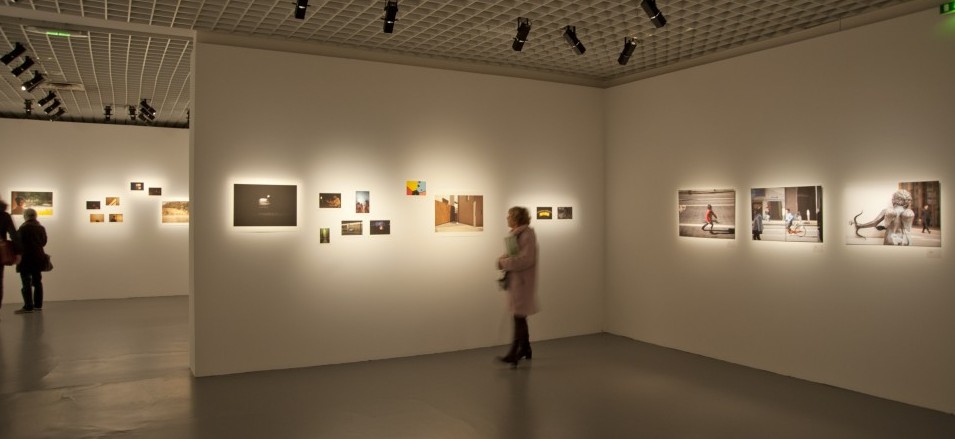
Arnaud Rodriguez: What very quickly became clear was that I wanted to question the every day life: what surrounds me and the daily practice of photography that goes with it. How can I show images of Japan, where I live, where I take photos every day that aren’t perfect, but which point out a detail and form a whole. My photographic work is an accumulation of images with no preconceived direction – apart from two or three subjects that interest me and which don’t appear here. And in the midst of these photographs, there are sometimes strong images that I feel attached to and that give off a special impression. They deserve to be looked at differently, they can be looked at on their own, without being part of a whole series.
From the outset of this project, I had in mind the idea of exhibiting a large number of images in a variety of formats, to reflect these two types of image. A selection of 15 photos in a row and in the same format, as originally envisaged, didn’t suit me: it would have taken away from the idea of multiplicity and the desire to compose with images of varying strength.
Initially, the layout was more rigid, with images grouped in twos, threes or fours. I was obsessed with the idea of bringing certain formats together and grouping them by aligning them (as in the newspaper Contrepoints exhibited in 2014). The whole, formed by these small groups of images juxtaposed with the larger formats, drew a sort of tighter cloud. I kept some of the alignments but gave the whole thing a more dynamic direction… It wasn’t coming alive enough! It’s perhaps a rather obvious metaphor, but the exhibition had to have the complexity of everyday life.
So I kept the idea of having several formats, and found a more fluid composition by adding breathing space, movement and very small formats. The smaller formats smoothed out the composition visually, gave it a better balance and allowed me to go further in this multiplicity of reading levels. In Contrepoints, I said that I was letting the viewer take part of the journey; I’ve kept this idea in mind. The viewer can look at each image or enter, in a non-linear way or not, into an overall reading.
On the walls that form a corner, I also wanted to give a feeling of continuity in the space, a linearity that goes beyond the framework of the wall. It was as if I wanted to stretch an additional thread between apparently distinct visual spaces. The viewer can see the walls separately or look for links between the different exhibition surfaces.
The result is that the viewer is obliged to move both closer and further away. The way the photographs are hung means that they have to move in depth, in addition to the usual journey along the exhibition wall. I myself love looking at photographs very closely in exhibitions, moving away and getting closer.
The choice of matte prints went hand in hand with the proximity needed to get a good look at certain images. I wanted material, like when you approach a painting. I wanted to create a relationship with the surface of the object, to give the print a presence, to make you notice the object and not just the image. Roland Barthes said: ‘A photograph is always invisible: it’s not what you see’. On the contrary, I wanted the photos to assert their presence, to stand out from the wall, and for us to observe the pigment and the granulation of the paper…
None of the images escape the viewer’s gaze, despite the different attention paid to them depending on the format and the tension between the photographs. How were the images chosen? Can they be chosen individually? How is the balance struck between the choice of image and the composition?
The large formats were obvious from the start. Most of the selection work was done on the other formats. There was a constant back-and-forth between the selection of images and the composition. Let’s just say that for more than half the photos, I didn’t hesitate for a second, but I still had to find a place for them in the overall picture.
I regularly searched my archives to modify the selection. Initially, I looked for a visual unity in the groupings. For the medium formats, I eliminated images that were too obvious, that gave too much away, that overpowered the others… And then I regretted not putting them in. So I looked at them differently, and put some of them back into their everyday context, and they found their place. Making the whole thing more fluid gave these photographs a place.
As for the very small formats, I think the final selection only includes two from the initial research. I really chose them when the walls of images were more or less complete, and when they allowed for this overall visual balance.
Once you’ve explored the entire exhibition space, you become aware of a wider level of reading that links your images to the presentation by Ferrante Ferranti, with whom you share this exhibition. How did the exchanges and links come about, and how was the dialogue between you established?
Ferrante sent me an initial selection very quickly. I was very familiar with his work, which was very different from mine, and this selection opened up yet another direction. It completely freed me up and I didn’t have to look for correspondences between my images and hers. From time to time I’d send him a few thoughts, a selection of images… and one day he sent me a selection of my photos. This helped me to make up my mind about some of my hesitations… He himself says that he made his final selection with my images in mind.
I was the first to decide, because I needed time to finalise the positioning. I positioned certain photos with his images in mind – which I had in front of me. Hence the large formats next to his walls in the first room. Hence the triptych on the right in the second room, to make a link with hers.
This exhibition project began with a theme common to all your photographs: working with light. In your case, was this theme the starting point for the shooting? The selection of images? The construction of space?
Is this really a common theme between Ferrante and myself? In any case, I don’t think we have the same approach. The strong sunlight and the play of shadows are very present in Ferrante’s work, and he knows how to wait for them and magnify them. And he doesn’t take any night photos, whereas night photos and artificial lighting are very common in my images. Even indoors, I’m happy with the half-light that creates a blur. With light, I’m very much a ‘make do’ photographer.
This imposed theme – as it was the theme of the FACTS festival – and which gave the exhibition its title, corresponded to a direction I had taken when I moved to Japan: the night. The photos of my neighbourhood, dimly lit at night, the half-light in Imperial Park, were the opposite of the lively moments at night-time parties. This was the starting point for this exhibition project. But very quickly, this direction bothered me because I also wanted to question the everyday, and as I said earlier, it was this idea of the everyday and of multiplicity that imposed itself.
I’ve kept the night shots and the dark atmospheres, which are still very present, but without restricting myself to them… I’ve also considered that the absence of light (i.e. the absence of contrast, bright colours, shadows…) is also part of my everyday photographic life. So there was no question of eliminating duller images in the literal sense. What’s more, such a display wouldn’t have worked with just night photos. A balance had to be maintained.
During the 5 months between the exhibition project and the final selection, I thought about this theme but I didn’t change my working rhythm, I just paid more attention, and I made more images than I would have made without this project. In September, at certain moments when the light was particularly strong or low, I thought about this theme again, and I said to myself: ‘now’s my chance! That’s how some of the photographs found their place at the last minute, in the very small formats.
Leave a Reply